MCP wrapper for Burp Suite that builds complete, well-formed HTTP requests from structured input + ingests dedup/JS exports for token-thrifty AI-assisted pentesting. Bundles a fixed Burp extension.







The MCP for Burp Suite that doesn't make your LLM hallucinate broken HTTP requests.
The problem
You hook up an LLM to Burp's official MCP server and ask it to "replay this request with a tampered cookie." It dutifully crafts a Repeater payload — and silently drops the Cookie header, gets a 401, and confidently tells you the endpoint requires no auth.
Or it forgets Content-Length. Or Host. Or uses LF instead of CRLF. Or pastes a JSON body with no headers at all.
This happens because the upstream Burp MCP takes a free-form content string. Whatever the model emits goes straight to the wire. There's no schema, no validation, no help.
The other thing that breaks long pentest sessions: token cost. Each get_proxy_http_history call ships kilobytes of repeated headers back to the model. Triage a target for an hour and you've burned a fortune re-paginating the same proxy history.
What this fixes
burp-mcp-plus is a Python MCP wrapper that sits between your LLM and Burp's official MCP server. Two big ideas:
1. Structured input, not free-form strings
Every tool that touches HTTP takes typed fields — method, path, set_headers, body — and a baseline (a real entry from Burp's history, or a URL). The wrapper builds the wire format itself. Correct CRLF, auto-Host, auto-Content-Length, default User-Agent, inherited cookies. The LLM literally cannot produce a malformed request because there's no content parameter to put a malformed request in.
2. Local file ingestion for the boring stuff
If you've already triaged a target with the bundled Deduped HTTP History + JS Exporter Burp extension, the wrapper indexes the exports on disk. dedup_search and js_search return file:line + 60-char snippets — meaningfully cheaper than re-hitting Burp every time the model wants to look at past traffic. Full content is only fetched on demand.
Architecture
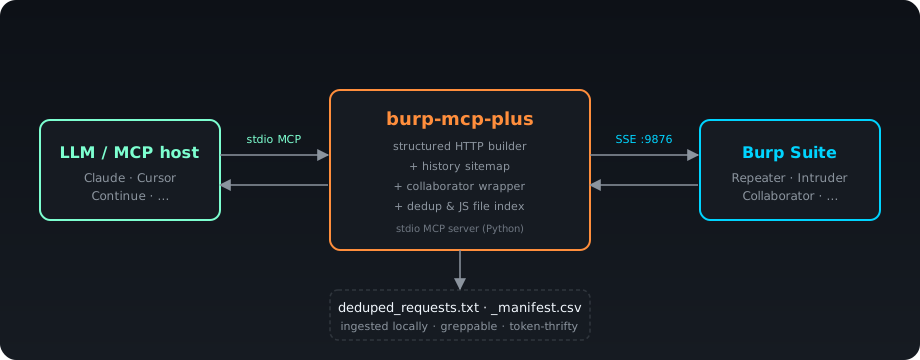
Plain Python stdio MCP server. Talks SSE to Burp's mcp-proxy-all extension on localhost:9876. Reads dedup/JS exports off disk. Works with any MCP host: Claude Desktop, Claude Code, Cursor, Continue, anything that speaks the protocol.
Features
Live Burp interaction
list_history/search_history— paginate or regex over proxy history. Returns compact summaries (id + method + url + status), not raw bytes.inspect_history_entry— pretty-print one entry's headers, body, target.repeater_from_history— clone a baseline, mutate any subset of (method, path, headers, body), push to Repeater. All other headers preserved verbatim from the baseline. Cookies, auth tokens, Sec-Fetch-, custom Anthropic- / X-* headers — all carry through.repeater_from_template— build from scratch with a URL. Optionally inherit auth from a history baseline.send_request— same shape, but actually sends and returns the response. Skip the Repeater dance when you just want to test.intruder_from_history— push to Intruder with§…§payload markers wrapped automatically around substrings you specify.sitemap— host → method → paths tree, synthesized from history. Burp's MCP doesn't expose Target; we synthesize one.collaborator_generate/collaborator_check— OOB canary payloads + interaction polling.
Local dedup file ingestion
Point at a deduped_requests.txt produced by the bundled extension and the model can search/replay endpoints from past sessions without round-tripping through Burp.
dedup_load/dedup_list— register file(s) under a name.dedup_search— regex overurl/request/response/params/all. Returns 60-char snippets.dedup_get— preview by default, full request/response on demand.dedup_to_repeater— replay a stored entry into a fresh Repeater tab with optional mutations. HTTP/2 lines auto-coerced to HTTP/1.1.
Local JS-export ingestion
Point at a _manifest.csv produced by the bundled extension's JS Exporter and the model can grep across all the JavaScript captured for a target.
js_load/js_list— register an export.js_files— browse the manifest, filter by host regex.js_search— grep across all on-disk JS. Returns file:line + snippet, max N matches per file (default 3). Transparently decodes the legacyarray('b', [...])byte-list format that older versions of the extension produced.js_read— fetch full content for files of interest.
Hardened against the real world
- Tolerates Burp's NDJSON-with-no-separators history format.
- Recovers parse-mid-stream when Burp truncates a long response with
... (truncated). strict=FalseJSON decoding for raw control bytes inside body strings.- Specific error messages for empty inputs, status markers, malformed entries — pointing the model at the next tool to call.
- 20 tests covering wire-format building and edge cases (no Burp required to run them).
Install
1. Burp side
Install MCP Server from Burp's BApp Store. Confirm it's listening on http://127.0.0.1:9876 (Output tab).
If you want the dedup/JS ingestion features, install the bundled extension:
- Set up Jython 2.7 in Burp → Settings → Extensions → Python environment.
- Burp → Extensions → Installed → Add → Python →
burp-extension/deduped_history.pyfrom this repo. - Two new tabs appear: Deduped History and JS Exporter.
Before you start capturing, two things the extension needs:
- Set your target scope. Burp → Target → Scope → add the host(s) you're testing (e.g.
https://app.acme.com/.*). The extension only dedupes/exports in-scope traffic, so this keeps the output clean and avoids ingesting random third-party noise (CDNs, analytics, etc.). - Pick an output directory for the JS Exporter. In the JS Exporter tab, set the output dir + project name before browsing. Files land at
<output_dir>/<project>/<host>/<flattened-path>/<file>.jsalong with a_manifest.csvthat the wrapper indexes.
Then browse the target. The Deduped History tab fills as new endpoints appear; the JS Exporter tab fills as new .js / .mjs responses come through. Hit Export in the Deduped History tab to write deduped_requests.txt.
2. Wrapper side
Requires Python 3.11+ and uv.
git clone https://github.com/titaniumtushar/burp-mcp-plus.git
cd burp-mcp-plus
uv sync
uv run pytest                  # offline tests; no Burp required
3. Wire it into your MCP host
Claude Desktop (~/Library/Application Support/Claude/claude_desktop_config.json on macOS):
{
  "mcpServers": {
    "burp": {
      "command": "/path/to/burp-suite-jdk/bin/java",
      "args": [
        "-jar", "/path/to/.BurpSuite/mcp-proxy/mcp-proxy-all.jar",
        "--sse-url", "http://127.0.0.1:9876"
      ]
    },
    "burp-plus": {
      "command": "/opt/homebrew/bin/uv",
      "args": [
        "run", "--directory", "/path/to/burp-mcp-plus", "burp-mcp-plus"
      ]
    }
  }
}
(Sample at examples/claude_desktop_config.json.)
Restart the host. Tools appear as mcp__burp-plus__*.
For Claude Code CLI, Cursor, Continue — same config shape, different config file. The MCP server itself doesn't care.
The bundled Burp extension
burp-extension/deduped_history.py is a Jython extension I wrote (and fixed — see CHANGELOG-equivalent notes below) that produces the dedup/JS exports the wrapper indexes.
Tab 1: Deduped History. Watches proxy traffic. Adds a row only when a new (method, host, path, parameters) tuple appears. Re-fires when new query/body parameter names show up on an endpoint. Export the whole thing to deduped_requests.txt.
Tab 2: JS Exporter. Watches for JavaScript responses, saves each unique JS file to <output>/<project>/<host>/<flattened-path>/<name>.js, writes a _manifest.csv. Detects version strings from filenames and content hashes.
Bug fix included: Older versions wrote JS files as Python array('b', [10, 10, ...]) literals instead of raw bytes (Jython slice-of-byte-array gotcha). The version in this repo writes proper bytes. The wrapper transparently decodes the old format too, so legacy exports keep working.
Token economics
Rough numbers from a typical pentest session:
| Action | Upstream Burp MCP | burp-mcp-plus | Reduction | | ------ | ---------------- | -------------- | --------- | | List 50 history entries | ~60 KB | ~3 KB | 95% | | Search history (regex, 30 hits) | ~90 KB | ~4 KB | 95% | | Replay one auth'd request | ~5 KB request + ~5 KB confirmation | ~1 KB | 80% | | Find an endpoint in past triage | re-paginate proxy (~60 KB) | dedup_search (~600 B) | 99% | | Grep all JS for a pattern | not feasible | ~2 KB w/ snippets | — |
The wrapper's job is to keep the model focused on the smallest bytes that answer the question.
Tested with
- Burp Suite Pro 2025.x
- Anthropic MCP Server BApp 1.x
- Claude Desktop on macOS
- Python 3.11, 3.12, 3.13
- macOS arm64, Linux x86_64
Should work on Windows but I haven't tested it. Reports welcome.
Security notes
This is a defensive tool for authorized testing. It's no more dangerous than Burp itself — but:
- The MCP exposes your Burp's full power to whatever model you connect. Don't connect untrusted models.
- File ingestion (
dedup_*,js_*) reads paths you provide. There's no sandbox; treat the wrapper's host as trusted. - The wrapper doesn't authenticate to Burp's MCP — it relies on Burp's
localhost-only binding. Don't expose Burp's MCP port externally. - Pentest scope discipline applies. The wrapper makes it easier to fire requests; it doesn't validate that you should.
Contributing
Issues and PRs welcome. A few ground rules:
- Tests stay green.
uv run pytestbefore opening a PR. The builder insrc/burp_mcp_plus/builder.pyis pure logic and easy to test offline. - No new free-form
contentparameters. That's the whole anti-pattern this tool exists to prevent. Add structured fields instead. - Compact returns. If a new tool would return more than a few KB by default, add a
limit/field/previewknob. - No hidden network calls. Tool side effects should be obvious from the name.
License
MIT.
Thanks
- PortSwigger — Burp Suite and the official MCP server.
- Anthropic — the MCP spec and Python SDK.
- Everyone running long pentest sessions who got tired of debugging "why did my LLM drop the Cookie header again."